
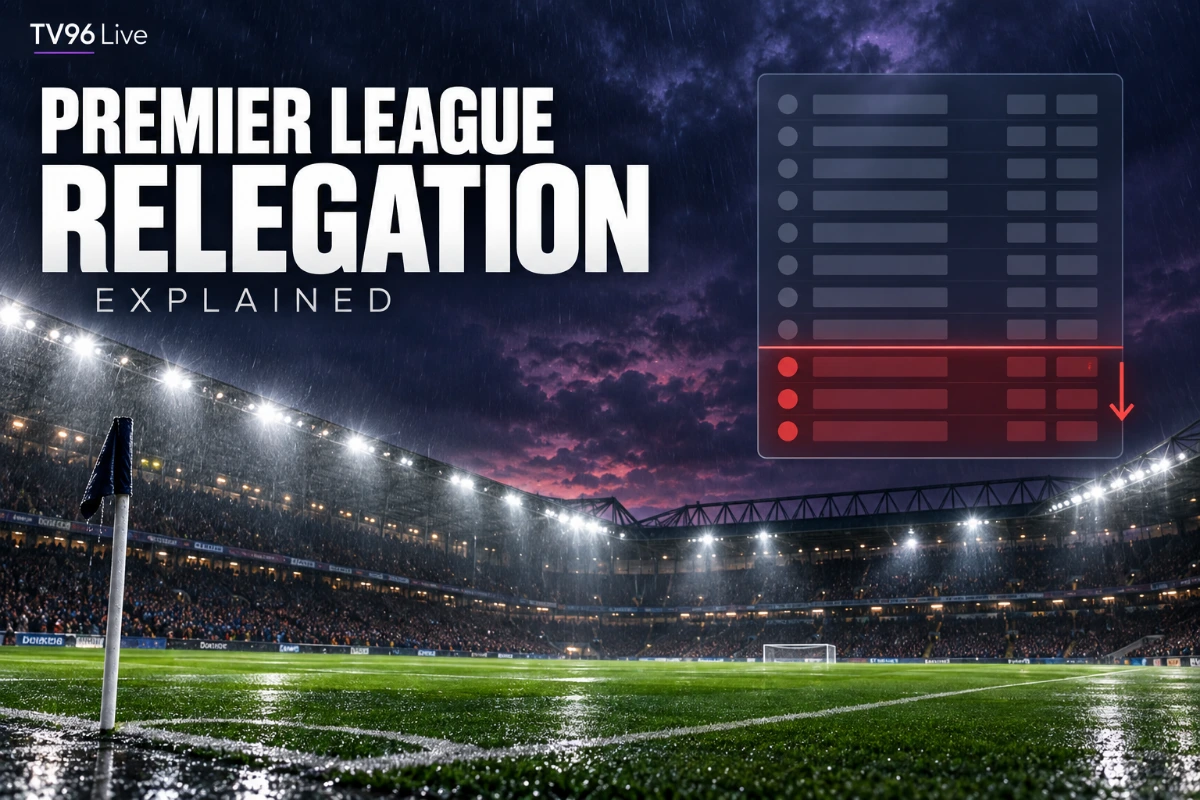
Relegation means moving down a division at the end of a season. In the Premier League, the clubs finishing in the bottom three places leave the top flight for the Championship. Their next season is played in a different league, against a different set of opponents and with a new competitive objective.
For supporters, the survival race can be as compelling as the title race. A draw between struggling teams can change the outlook for several clubs, while a late goal elsewhere can determine whether a side remains above the boundary.
Which positions go down?
The Premier League has 20 teams, and the final positions 18, 19 and 20 are the relegation places. Seventeenth is the lowest finishing position that retains a place for the next campaign. These are final-season outcomes, not automatic consequences of spending a week near the bottom.
A team sitting 18th in October has time to recover. A team in 17th with a narrow lead in May may still be in serious danger. The position needs to be read alongside the points gap, matches remaining and applicable tiebreakers.
How promotion completes the exchange
Three Championship clubs replace the relegated teams. The top two go up automatically and a play-off decides the remaining place. Check the EFL announcement for the season's play-off field and schedule. Third place does not itself guarantee promotion.
The exchange keeps the Premier League at 20 clubs. A relegated club can aim for an immediate return, but it must earn promotion through the next Championship campaign. There is no automatic return ticket based on its previous top-flight status.
This is why the two competitions should be considered together when discussing a club's future. Survival preserves one kind of schedule and sporting opportunity; relegation begins another contest rather than ending the club's football story.
Points matter before goal difference
A win earns three points and a draw one. When teams finish level on points, the Premier League compares overall goal difference and then goals scored, with further rules available for unresolved consequential ties. A better goal difference cannot make up a points deficit.
Suppose two invented teams have one game remaining. Green Town has 35 points and −18 GD; Red United has 33 points and −5. Green Town is currently ahead despite its much worse goal difference. If Green Town loses and Red United wins, Red United reaches 36 and moves ahead on points.
If Green Town draws, it reaches 36. A Red United win also produces 36, so tiebreaking becomes important. The winning margin and any goals conceded matter to the updated figures. Our goal difference guide explains how a match changes those numbers.
When is a club mathematically safe?
Mathematical safety means the remaining possible results cannot push a club into the relegation places. It is stronger than saying survival is likely. A comfortable-looking points total is not, on its own, proof.
As a first check, multiply a rival's remaining matches by three and add that to its current points. If a club has 28 points with three games left, its maximum from results is 37. But a full safety calculation may involve several rivals, tiebreakers and matches those rivals still play against each other.
For that reason, avoid declaring safety from a single pairwise comparison. A team need only finish above three clubs, and several teams can still exchange positions. Official confirmation is preferable when the permutations are complicated.
Why there is no permanent survival target
Supporters often use a round points number as a target, but the required total depends on the season's results. The same tally can be enough in one campaign and insufficient in another. A target is a planning tool, not a rule in the competition regulations.
The remaining schedule also matters. Two clubs with identical points can face different combinations of opponents and home fixtures. A run-in assessment should name those fixtures and distinguish evidence from prediction rather than converting difficulty into points before the matches happen.
What changes after relegation?
Competitively, the immediate goal often changes from staying in the top division to winning promotion back to it. Squad depth, playing style and recruitment may need reassessment for the new competition. Experienced players may remain valuable, but previous Premier League status does not guarantee superior results.
Commercially, a change of division can alter broadcasting income, sponsorship arrangements and the affordability of the squad. The effect differs between clubs because contracts, spending commitments and support arrangements differ. Do not attach a universal loss figure to every relegation without examining a club's accounts and current rules.
Following the survival race on TV96 Live
Use Standings to compare the clubs around 17th and 18th, checking played matches before interpreting a gap. Use Matches for available results and upcoming fixtures. A delayed table can temporarily disagree with a newly completed match.
Track the changing points gap and the number of remaining opportunities. That provides a clearer account of the survival race than labelling every match a must-win, especially when a draw or another club's result can also alter the outcome.