
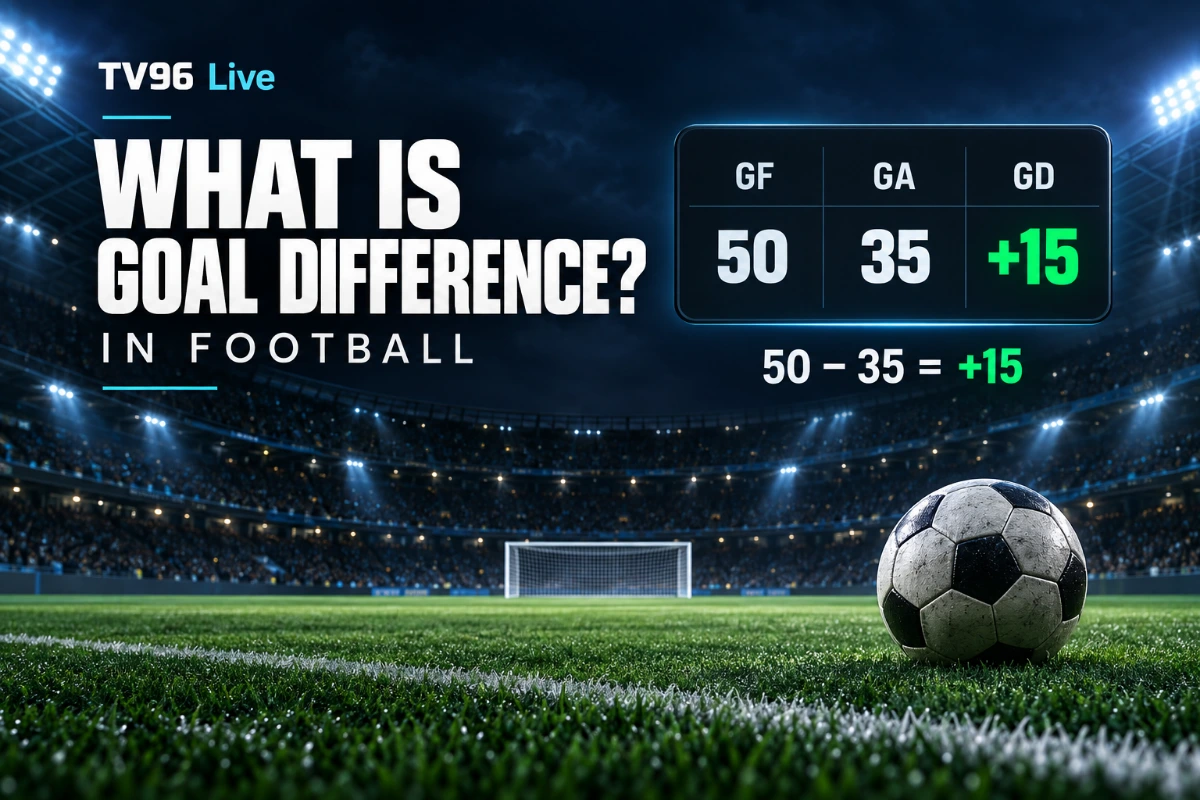
Goal difference is the number of goals a team has scored minus the number it has conceded in the competition being measured. A side with 30 goals scored and 20 conceded has a goal difference of plus 10. The calculation is simple; interpreting what that number means requires a little more care.
It can help separate teams tied on points and reveal whether a season's results have been built on narrow margins or more comfortable performances. It does not replace points, and it is not the first tiebreaker in every competition.
GF, GA and GD
GF means goals for: goals credited to the team. GA means goals against: goals credited to its opponents. GD is goal difference. Some tables abbreviate these columns differently, so check the labels rather than relying only on their position.
The formula is GD = GF − GA. There is no division, percentage or weighting for home and away goals. League-table GD normally counts league matches only. A spectacular cup victory does not improve a team's domestic league goal difference.
Three worked examples
All the teams below are invented. North FC has scored 42 and conceded 28: 42 minus 28 is +14. Riverside has scored 31 and conceded 31: its GD is zero. Harbour has scored 24 and conceded 39: its GD is −15.
A negative number is not a mathematical error. It means the team has conceded more goals than it has scored. Between −4 and −9, −4 is the better goal difference because it is closer to zero. A side does not need a positive GD to have a better one than its rival.
Now suppose Harbour wins its next game 3–0. Its totals become 27 scored and 39 conceded, giving −12. The victory improves GD by three, although the total remains negative. If it instead draws 2–2, both GF and GA rise by two and GD stays at −15.
Why one match can change the comparison quickly
When two rivals meet, a decisive score affects both columns in opposite directions. Suppose North has +5 and Riverside has +2 before their match. If Riverside wins 2–0, North falls to +3 and Riverside rises to +4. A two-goal victory changes the gap between their goal differences by four.
This is a useful distinction between the change to one team's number and the swing between two teams. It also explains why a late goal can matter even when it does not change who wins a match. It improves one side's tiebreaking position and worsens the other's.
How it affects league position
In the Premier League, points come first and overall GD is the next comparison when points are equal. If North has 50 points and +2 while Riverside has 49 points and +20, North is still higher. The much better GD does not cancel a one-point deficit.
If both finish on 50 points, the GD comparison becomes relevant. If their GD is also equal, the rules move to another criterion, including goals scored in the Premier League. Our Premier League structure guide places these steps in the wider table system.
Other competitions can give head-to-head records priority or require a play-off in specific circumstances. Never describe a team as safe or champion on goal difference without checking that competition's rules. A live data table is especially poor evidence for settling an unusual multi-team tie.
What GD can and cannot tell you about performance
GD captures scoring and conceding together, which makes it more balanced than goals scored alone. However, the same +10 can come from 50 scored and 40 conceded or 30 scored and 20 conceded. Those profiles suggest different matches and different strengths.
Distribution matters too. A fictional team winning one match 6–0 and losing five matches 1–0 would have a positive GD of +1 but only three points from those six games. A large victory can mask repeated narrow defeats. Read the results alongside the total before calling a positive number evidence of consistent success.
Goal difference also records outcomes rather than the quality of chances. Finishing, goalkeeping and unusual incidents can influence a short sample. Expected goals offers another way to examine chances, while still leaving the actual score as the result that counts.
A quick table-reading routine
On Standings, check points, games played, GF, GA and GD in that order. Ask whether the clubs have completed comparable schedules and whether one unusually large result is driving the difference. Then consult the official rules if a tied position has consequences.
Keep the central distinction clear: GD measures the net goal balance, while points measure the reward for results. Using both gives a fuller picture than asking either number to explain the whole season.